Land Acquisition
Nava Raipur (Atal Nagar) Land Acquisition: Model, Rates, Villages and Disputes
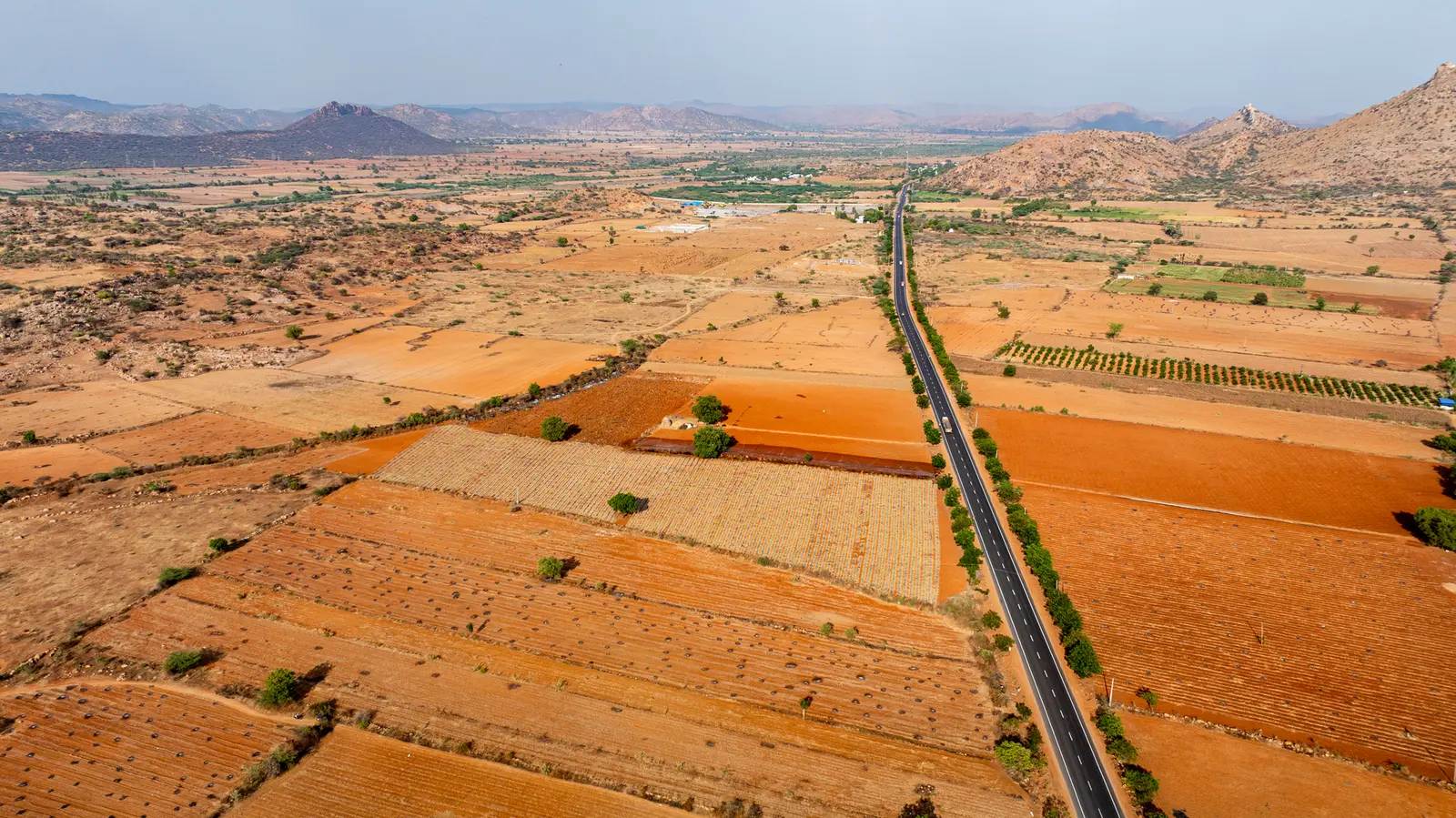
Chhattisgarh's new capital Nava Raipur (Atal Nagar) has been built by acquiring farmland from villages near Raipur since the mid-2000s, mostly through negotiated purchase rather than formal land acquisition law, but the process remains only partly complete and is still contested by farmers in court more than two decades on.
| Land originally earmarked | 23,742 hectares across 41 villages (2002 plan) |
|---|---|
| Land actually acquired so far | ~13,000 hectares from 27 villages (as of March 2026 reporting) |
| Core city footprint | ~8,000 hectares across 27 'core' villages |
| Current compensation rate — irrigated land | ~Rs 5.9 lakh per acre (as of March 2026) |
| Current compensation rate — unirrigated land | ~Rs 5.4 lakh per acre (as of March 2026) |
| Lowest reported forced rate | Rs 4.30 lakh per hectare, Baroda village (2009 emergency-clause acquisitions) |
| Farmer petitions in Chhattisgarh High Court | 6,000+ filed since 2011, per Capital-Affected Farmers' Welfare Committee |
| Estimated affected population | 50,000+ families; up to ~2,50,000 people |
| NRDA debt status | Declared debt-free in April 2025 after clearing a ~Rs 1,200 crore debt |
Acquisition model: consent purchase, not just the Land Acquisition Act
A 2006 state government order emphasised that the agricultural land required for the development shall be purchased from the farmers on mutual consent instead of acquiring the land under the Land Acquisition Act, as far as possible. The process of land procurement for Naya Raipur was built around consensus, with over 8,500 hectares procured through a mix of private purchases, land acquisition, and government land transfers.
A special committee was formed to determine land rates, which were negotiated to be 3 to 5 times the existing rates. Farmers who agreed to sell were meant to get more than cash: those who agreed to give their lands under mutual consent were entitled to special rehabilitation benefits such as land for horticulture/floriculture, utility shops or a residential plot, free of cost.
In practice, the consent framework has been backed by compulsion. Notices were issued asking farmers to hand over land through mutual agreement, failing which it would be acquired — a process that farmers' leaders say triggered protests that continue to this day. In July 2009, when NRDA was offering Rs 14.75 lakh per hectare, the government invoked an emergency clause, granting itself the authority to acquire land within just 15 days of issuing a notice through the district collector. Farmers point out that a 2005 government ban on land sales to anyone except NRDA in these villages undercuts the idea of a free 'mutual agreement.'
Current compensation rates
Current rates offered by the authority are around Rs 5.9 lakh per acre for irrigated land and Rs 5.4 lakh for unirrigated land. Farmers argue these rates are far below market value. Nearby unrestricted land, according to farmer representatives, is being sold for between Rs 1 crore and Rs 2.5 crore per acre.
Rates have shifted markedly over the life of the project: the sale of village land in 2006 was carried out at a rate of Rs 12.37 lakh per hectare, a figure that included compensation. Under the 2009 emergency-clause provision, residents of Baroda village say they were coerced into accepting a rate of Rs 4.30 lakh per hectare.
Farmers also point to the gap between acquisition price and what NRDA later charges for the same land. NRDA has later leased acquired land at Rs 1.14 crore per hectare for residential use and Rs 1.82 crore per hectare for retail purposes. NRDA disputes the unfairness claims, saying restrictions are meant to protect farmers from middlemen and that compensation is fair.
Beyond one-time payment, some project-affected families also receive recurring support: annuity payments are being provided to project-affected families from 2012 to 2031. By 2022, farmer representatives said the affected farmers were being paid Rs 15,000 per year, which many claimed has been stopped.
Villages covered
All affected villages lie in Raipur district, in the area between Raipur and the Swami Vivekananda Airport. In 2002, NRDA decided to acquire 23,742 hectares across 41 villages, about 17 km southeast of Raipur. Sixty-one villages were initially incorporated into the project, but in 2005 the incoming state government narrowed its scope from 61 villages to 41, and imposed a ban on the sale and purchase of land in 27 of these 41 villages. More than 13,000 hectares have been acquired so far from 27 villages, according to NRDA.
Key villages named in reporting and disputes include:
- Pauta — where the state government laid the foundation stone for Naya Raipur in 2002.
- Rakhi — site of a resettlement colony and a major protest; on November 7, 2017, 117 residents of Rakhi village were arrested and detained for two hours while protesting forceful evacuations and the demolition of 21 houses.
- Jhanjh / Jhanjh-Nawagaon — Jhanjh is a village displaced to make way for Nava Raipur Atal Nagar, and a resettlement colony of 20 one-room units was built at Jhanj-Navagaon.
- Baroda — where residents were coerced into accepting Rs 4.30 lakh per hectare under the 2009 emergency clause.
- Titha — home to displaced residents who say promised jobs never materialised, per Ashok Kumar, a displaced resident of Titha village.
- Chicha — where, according to farmer leaders, infrastructure has been built over commons land, including a road passing through a graveyard.
Budget and finances
Cost estimates for Naya Raipur have grown far beyond the original plan. Early planning documents put the project cost at anywhere between Rs 1,500 and 2,000 crore. By 2022, farmer groups estimated over Rs 10,000 crore had been spent to develop the city, with projects worth nearly Rs 20,000 crore in progress.
NRDA itself ran into financial trouble funding land acquisition and infrastructure. The authority slipped into a debt of Rs 1,200 crore, and its assets were seized by banks and declared non-performing. The state government has since worked to fix this: through the third supplementary budget for 2024–25, the state government allocated ₹1,043 crore to the Nava Raipur Atal Nagar Vikas Pradhikaran. By April 2025, officials announced that the authority had achieved debt freedom, after having earlier availed substantial loans primarily for land acquisition, roads, government offices and institutional facilities, whose servicing had pressured its cash flow.
Separately, farmer leaders allege that common land was used to raise finance: around 2,764 hectares of common land — including ponds, pastures and graveyards — was transferred for the project and subsequently mortgaged to the Housing and Urban Development Corporation for a loan of Rs 555 crore.
Disputes and farmer negotiations
Compensation, not the project itself, has been the core grievance for two decades. It is the rate of compensation that has created the deadlock — farmers say they are not against the project but want a fair rate and a proper rehabilitation package.
Litigation has run for over a decade: since 2011, more than 6,000 farmers have filed petitions in the High Court of Chhattisgarh in Bilaspur seeking fair compensation and rehabilitation for land they say was acquired forcibly and through fraudulent means. In February 2012, the high court stayed the land acquisition proceedings over allegations of coercion and fraud, but a different judge immediately lifted the stay order.
Protests have periodically escalated. In 2018, farmers undertook a 112-km protest march from Raipur to Bilaspur to file their lawsuits, challenging the government's methods of land acquisition. Over 1,500 farmers marched from Raipur to Bilaspur, sitting on strike outside the high court and submitting a memorandum of demands. In January 2022, thousands of farmers launched an indefinite strike in the Nava Raipur area seeking compensation, reaching the protest site with tents and grain to press a decade-long struggle.
NRDA's position differs sharply from farmers'. The authority maintains that land was acquired through agreements with farmers, and disputes claims of unfairness, saying restrictions are meant to protect farmers from middlemen and that compensation is fair. On rehabilitation, officials say displaced families have been provided alternative housing, with two resettlement colonies developed — 20 one-room units in Jhanj-Navagaon and around 200 houses of about 400 sq ft each in Rakhi village. Farmers counter that this has come at a personal cost; the prolonged legal battle has taken a toll, with at least four farmers who filed petitions having died while waiting for a resolution, according to their committee.
Land-use split (master plan)
Under the original Naya Raipur Development Plan, the roughly 8,000-hectare core acquisition was earmarked as follows: about half of the total acquired land is for afforestation, roads, parks, public conveniences and water facilities/canals/green belts; 23 percent is reserved for educational institutions, government offices and public auditoriums; and 30 percent is for residential and economic uses.
Current stage (as of mid-2026)
Land acquisition remains incomplete relative to the original 2002 plan. More than 25 years after it was first planned, Nava Raipur remains incomplete; the project involves the acquisition of more than 23,000 hectares of land from 41 villages, and this has affected an estimated 250,000 people. NRDA says more than 13,000 hectares have actually been acquired so far, from 27 of the 41 villages.
On the ground, construction has picked up pace even as compensation disputes persist. Despite grievances, development has continued — the built-up township now spans over 8,000 hectares and includes six-lane roads, residential complexes, a hospital, an international cricket stadium, a new secretariat, the legislative assembly, a jungle safari, a botanical garden and a central park. Four ministers have shifted residence to Nava Raipur, the chief minister's official home is ready, and the Assembly was expected to begin functioning from the new capital by September 2025.
Investment activity has accelerated under the current state government: in the one-and-a-half years before mid-2025, the state signed investment MoUs worth over Rs 4,500 crore for Nava Raipur. Yet occupancy still lags the master plan, and the population remains about half of what the Naya Raipur development plan projected. Farmer litigation continues in parallel: in 2018 farmers undertook a 112-km protest march from Raipur to Bilaspur to challenge the government's methods of land acquisition, and cases from that movement remain before the Chhattisgarh High Court as of the most recent reporting in 2026.
Land use
Frequently asked questions
Is land for Nava Raipur being acquired under the Land Acquisition Act or by consent?
Primarily by consent/negotiated purchase. A 2006 state order directed that farmland for the project be bought via mutual agreement rather than compulsory acquisition wherever possible, though an emergency clause was invoked in 2009 to speed up acquisition in some villages, and farmers argue the 2005 ban on selling land to anyone but NRDA made 'mutual consent' effectively compulsory.
What are the current land compensation rates in Nava Raipur?
As of March 2026, NRDA's offered rates are about Rs 5.9 lakh per acre for irrigated land and Rs 5.4 lakh per acre for unirrigated land. Farmers say these are far below the open-market price of nearby unrestricted land, which they put at Rs 1 crore to Rs 2.5 crore per acre.
How much land has actually been acquired so far?
NRDA reports more than 13,000 hectares acquired from 27 of the 41 villages originally identified, against an original target of 23,742 hectares across all 41 villages set out in the 2002 plan.
Which villages are most associated with land disputes?
Rakhi (site of a 2017 mass demolition and arrests), Jhanjh/Jhanjh-Nawagaon (a resettlement colony), Baroda (site of a disputed 2009 forced-rate acquisition), Titha and Chicha are among the villages most frequently named in reporting on compensation and displacement disputes.
Are there ongoing legal disputes over land acquisition?
Yes. More than 6,000 farmers have filed petitions in the Chhattisgarh High Court in Bilaspur since 2011 seeking fair compensation and rehabilitation, and farmer groups have organised marches, strikes and sit-ins, including a 112-km march to Bilaspur in 2018 and an indefinite strike in January 2022.
What is NRDA's financial position now?
NRDA had built up around Rs 1,200 crore in debt from land acquisition and construction costs, leading to seized, non-performing assets. The state government allocated Rs 1,043 crore to the authority through its 2024-25 third supplementary budget and announced in April 2025 that NRDA had become debt-free.
What is the current stage of the Nava Raipur project overall?
As of 2026, the city remains unfinished more than two decades after planning began, with roughly 13,000 of the targeted 23,000-plus hectares acquired. Construction of government buildings, roads and some private investment has picked up pace, but population and occupancy remain well below the master plan's targets, and compensation litigation continues.
Sources
- A capital built on waiting: Inside the unfinished city of Nava Raipur and the lives left behind — Down To Earth
- Displaced for Nava Raipur: Farmers Fight Forced Land Acquisition, Poor Compensation and Broken Promises — Down To Earth
- Farmers Oppose Land Acquisition for Development of Naya Raipur in Chhattisgarh — Land Conflict Watch
- Naya Raipur hits farmer roadblock — Business Standard
- 'Every Party Duped Us': Nava Raipur Farmers Want Govt to Keep Promise in Chhattisgarh — The Quint
- CONNECTKaro 2015 - Land Management For Smart Cities - Naya Raipur
- Naya Raipur Development Authority FINAL REPORT — World Bank
- Setting New Urban Standards: Nava Raipur Atal Nagar, India's First Debt-Free Planned City — The Wire
- Nava Raipur is becoming the capital it was meant to be — ThePrint
- Naya Raipur, New Raipur, Chhattisgarh — nayaraipur.org